I write about work, money and building beyond a salary.
Share
A Simple Way to Manage Money That Doesn’t Make You Feel Like Throwing Up
Published about 2 years ago • 3 min read
Hello Reader,
Having tried many budgeting apps and tools, I’ve concluded that low-tech and simple is best.
There are countless tools, apps, spreadsheets, and even courses and programs teaching you fanciful money management techniques.
All they do is distract you and avoid the inevitable truth behind why you think you need all these fancy tools:
That somehow using these fancy tools will make you feel better and more confident about managing your money.
That’s just not true.
The real reason dealing with money makes you feel queasy is because you doubt you can make the money you want and need.
Yes, it goes deeper than the latest money management strategy, tactic, and tool.
You have to face your fear, doubt, and lack of confidence you can make the money you need for the life you want.
When you work on this self-belief and confidence, what tool you use doesn’t matter.
Because you can make any tool work for you.
Instead of spending all your time and energy learning how to use these tools, and even paying money for them, spend your time working on having the self-belief and confidence you can create any result you want.
When you become courageous and confident, and believe you can create the result you want, you approach everything with a different mindset and energy.
You'll begin to use money as the tool it’s intended to be to live the life you want.
Here are 3 steps to become courageous and confident about your money.
Step 1: Face the facts.
Get clear on what your current financial situation is.
Gather all the relevant information - your bank and credit card statements, all your investments, savings, sources of income, anything, and everything you spend money on.
This first step will probably take you the longest time, but it’s the critical first step if you truly want to be courageous and confident about your financial situation.
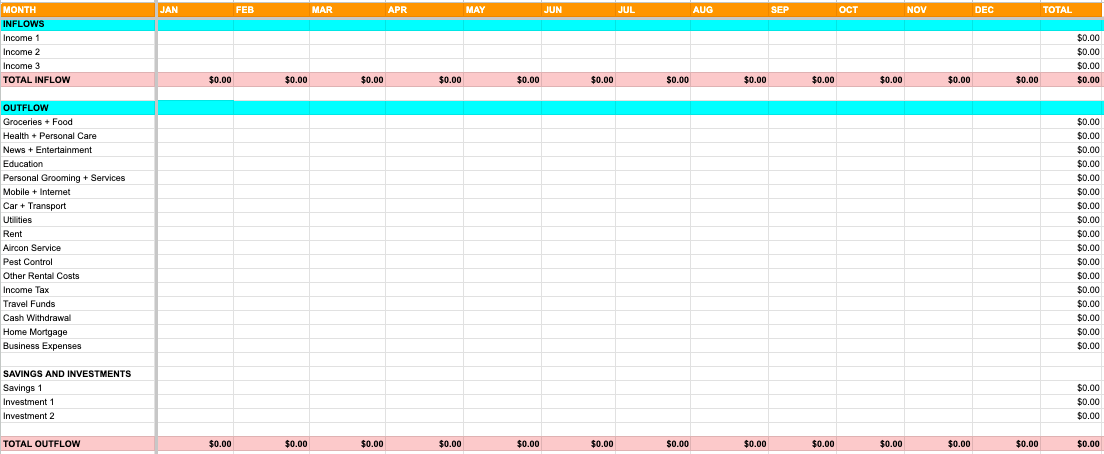
Step 2: Put everything you found into a simple spreadsheet.
Here’s what mine looks like:
My Simple Money Management Google Sheet
I also have a section on upcoming annual payments so I'm never caught off guard by 'emergency' money situations:
My Simple Money Management Google Sheet
It will take some time initially to familiarize yourself with updating this information.
But after a couple of months, you’ll devise your own shortcuts to do this quickly.
For example, I consolidate all my expenses into one credit card and print the statement out to update my spreadsheet.
Consolidating my spending lets me accumulate rebates I can then use to offset expenses.
This makes it fast and easy to do.
Step 3: Identify gaps between where you are now and where you want to be and take concrete steps to close the gap.
When I found myself in a 6-figure business debt and without a job, I decided never to be clueless about money again.
I educated myself about money by reading books, listening to podcasts, and attending webinars.
To make additional income, I started a business on the side of my full-time job and took up freelancing training gigs.
I also asked for more pay and flexible working hours from my employer.
Ultimately, the most difficult thing was dealing with the negative thoughts and feelings I had while working through this system to get my money organized.
I wanted to give up because I felt so overwhelmed, lost, and confused.
I didn’t know where to begin and the moment I started working on it, I’d panic because all I could see was how big the gap was between where I was and where I wanted to be.
I realized I needed to work on my mindset and calm myself down so I could continue to handle my money clearly and confidently and keep taking small steps towards my goals.
Bonus Step: Find a way to handle any unhelpful and disempowering thoughts and emotions that arise as you start taking steps toward achieving your financial goals.
Luckily, I found the MAP Method, or rather it found me when I read about a lady who was teaching this method in our local newspaper one day.
I contacted her and the rest is history. She became my trainer and supervisor in the MAP Method when I decided to get certified in it.
At first, it was to help myself.
But the MAP Method was so effective I started teaching it to other women who wanted to master their thoughts and emotions about money so they too could take those consistent actions to achieve their financial goals.
Conclusion
When it comes to budgeting and mastering your money, you really don’t need any fancy tools or apps.
It’s a simple process:
Face the facts.
Organize everything into a simple spreadsheet.
Identify gaps between where you are and where you want to be, then take concrete steps to close the gap.
Bonus step: Handle any unhelpful and disempowering thoughts and emotions that arise as you work through these action steps.
The problem isn’t the how-to's, but your ability to handle all your negative thoughts and emotions as you work through it and keep taking consistent action to achieve your financial goals.
Find a way like meditation or journaling to handle the unhelpful and disempowering thoughts and emotions so you can keep going for your dreams.
I hope this guide helps you see managing your money doesn't have to be scary or complicated.
Talk to you again next week.
Sharon
P.S. If you want to experience how the MAP Method works and use it to feel calm and confident about money, book a call with me to learn more.
Building a $20k/month business alongside my HR job. Sharing how I do it with limited time, energy, and zero room to risk my job in my weekly newsletter. Subscribe to follow along.
I write about work, money and building beyond a salary.
Hello Reader, 🎧 Prefer listening? Apple Podcast | Spotify — I felt a little sick after making that payment. It was for a mastermind I’d been thinking about for months. And the next day, the doubts came almost immediately. What if it doesn’t work? What were you thinking? You could’ve used that money for the kids’ university. — This is something people don’t talk about enough. Making decisions about money when you’re responsible for more than just yourself. — I didn’t make this decision...
Hello Reader, Prefer to listen instead? 🎧 Listen to the episode here (This is the audio version of this week’s Career Design Notes.) There are many ways to build a career. You can: climb the corporate ladder stay and deepen in your role start a business build something on the side Most people don’t choose. They default. I didn’t. I chose to build a business while keeping my job. Not because it’s easy. But because the alternatives were unacceptable. I didn’t want: to depend on a single income...
Hello Reader, I hope this message finds you well! I'm excited to share that this week's podcast episode is now live, and it's all about taking the crucial first step towards breaking the cycle of financial anxiety, a journey that I believe is empowering and transformative. This week's episode dives deep into understanding financial resilience and how it can move you from financial anxiety to confidence and calm in handling your financial affairs. Podcast Episode Overview: Breaking the Cycle...